
Weeks ago, I used AI at home to solve something in minutes that would've taken me hours at work. Same models. Same capabilities. Completely different experience. That gap isn't random, and it isn't a technology problem.
The Assumption: "My Job is Too Complex for a System"
Most people believe their workday is a series of unique, expert-level judgments. They say, "My job isn't repeatable." And they're right—on the surface. If you look at a mountain from a distance, it looks like one solid, immovable object. But if you get close enough, the mountain is just a collection of pebbles.
The Observation: The "Pebbles" of Expert Work
When I mapped my own role, the "expertise" I thought I was providing started to look like a series of predictable triggers. What felt like intuition was actually a pattern:
The Trigger: A 10% drop in weekly engagement.
The Source: Checking the Salesforce Marketing Cloud dashboard.
The Decision Path: If the drop is in "Open Rate," check the subject line; if it's in "Click Rate," check the CTA button.
The thinking wasn't random. It was structured—it was just undocumented.
The Reality: We Are Asking AI to Play Without a Rulebook
AI feels clunky at work because we're asking it to operate across disconnected tools and navigate workflows that only exist in our heads. We expect "Human-Level Judgment" without providing the "System-Level Logic."
Meanwhile, enterprise reality is a graveyard of:
Siloed data that AI can't access.
Fragmented systems with no clear handoffs.
Hidden friction that adds effort before it removes it.
The limitation isn't the model's intelligence; it's the environment's illegibility. AI doesn't transform work by being added to it. It transforms work when the workflow is rebuilt to be machine-operable.
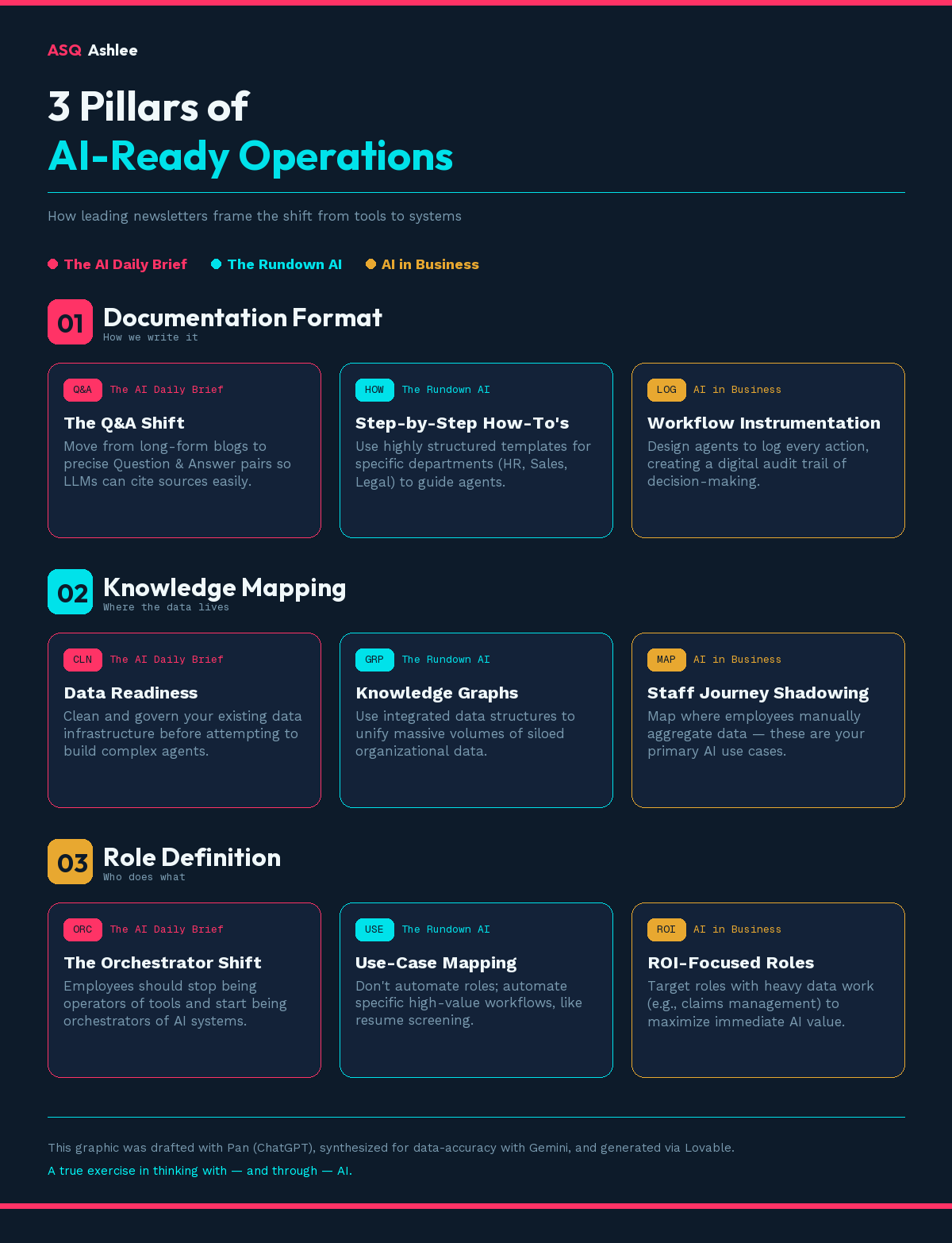
This piece was tested across a multi-model environment. Drafted with Pan (ChatGPT), stress-tested for bias with Grok, synthesized for data-accuracy with Gemini, and deployed via Lovable. A true exercise in thinking with—and through—AI.